The Youngest National Teams at the World Cup
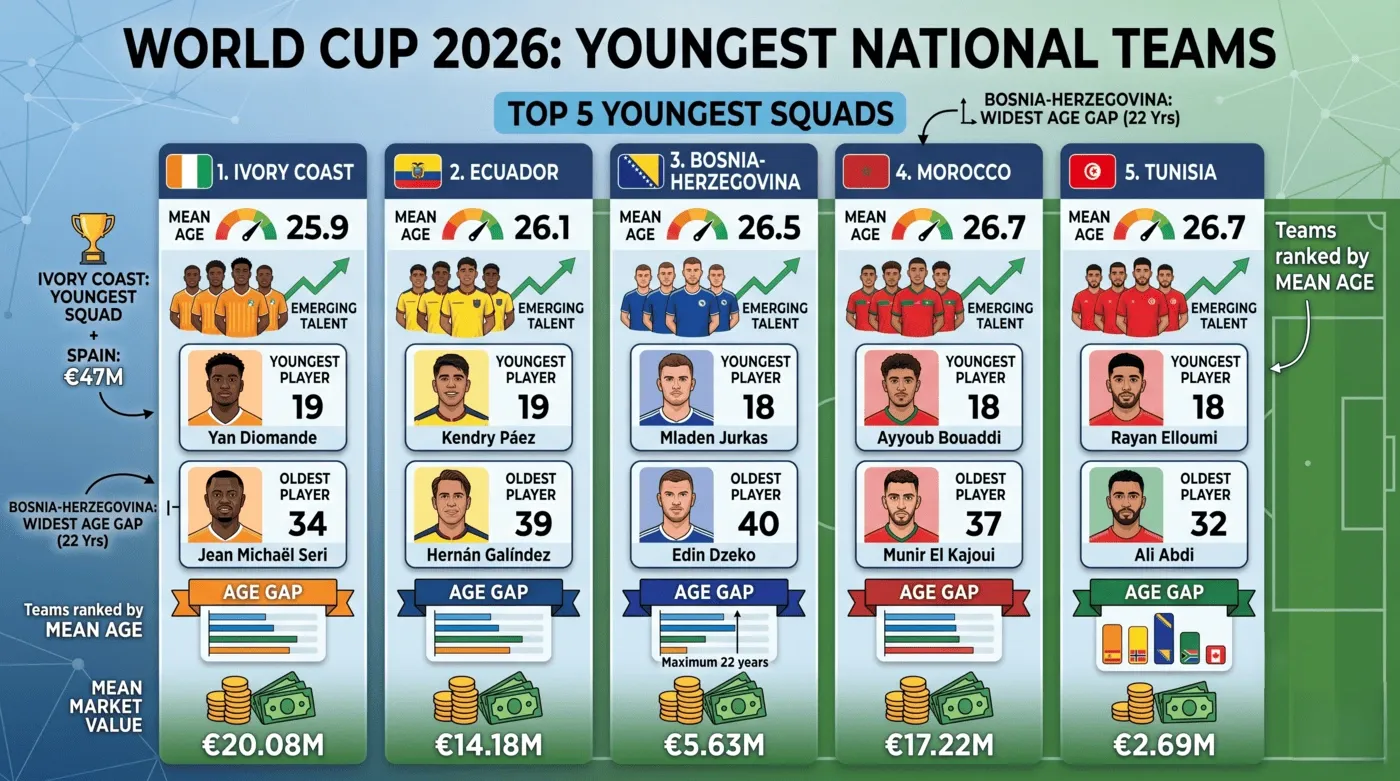
A 2026 report found that Côte d'Ivoire has the youngest team in the World Cup. With FIFA 2026 in full swing, a new study by the football predictions platform The Daily Punt analyzed the age range of every squad at the tournament to see which nations are building around emerging talent.
- Ivory Coast has the youngest World Cup squad with a mean age just below 26.
- With 18‑year‑old Mladen Jurkas and 40‑year‑old Edin Dzeko in the same squad, Bosnia‑Herzegovina has the widest age gap at 22 years.
- Spain has the priciest youngest team at €47 million per player.
To identify the youngest squads at the World Cup, the study looked at the average age of each squad, the youngest and oldest players in each team, and the age gap between them. The ranking was based on mean squad age, with lower averages indicating younger teams. The study also looked at each team’s success and how much money they earned.
Here are the 10 youngest teams in the World Cup:
You can access the complete research findings here.
1. Ivory Coast
- Mean Age: 25.9
- Youngest player: Yan Diomande
- Youngest age: 19
- Oldest player: Jean MichaëlSeri
- Oldest age: 34
- Min/max age difference: 15
- Mean Market Value: €20.08M
Ivory Coast has the youngest squad in the World Cup, with an average age of 25.9. Yan Diomande is just 19, while Jean Michaël Seri is 34, a 15‑year spread between the team's freshest face and its most seasoned player. Several teenagers and players in their early twenties fill out the roster, and that young talent comes with serious transfer clout, with the average player priced at around €20 million.
2. Ecuador
Ecuador follows closely with an average age of 26.1. The age difference between Kendry Páez, 19, and Hernán Galíndez, 39, stretches to 20 years, one of the widest margins in the top five. The squad leans heavily on young players in their early twenties, and the typical squad member is valued at €14 million, reflecting a healthy blend of up‑and‑coming talent and steady older heads.
3. Bosnia‑Herzegovina
Bosnia‑Herzegovina sits third with an average age of 26.5. Mladen Jurkas is just 18, while Edin Džeko is 40, a 22‑year gap that is the biggest among the top five. Teenagers and early‑twenties players supply energy, while veterans like Džeko offer composure and experience. The average market worth of €5.6 million per player points to a squad still carving out its reputation on the global stage.
4. Morocco
Morocco comes fourth with an average age of 26.7. Ayyoub Bouaddi, 18, lines up alongside Munir El Kajoui, 37, a 19‑year divide that brings both spark and stability. A solid core of players in their mid‑twenties forms the backbone of the team, with a handful of teenagers adding youthful energy. With each player carrying an average fee of €17 million, the squad combines promising youngsters with established performers.
5. Tunisia
Tunisia rounds out the top five, also averaging 26.7 years. Rayan Elloumi, 18, and Ali Abdi, 32, account for a 14‑year range, the narrowest among these nations. The roster mixes younger faces with experienced footballers, though the average transfer valuation of €2.7 million per player sits at the lower end. That modest price tag, paired with a tighter age bracket, gives Tunisia a different profile from the teams ahead of them.